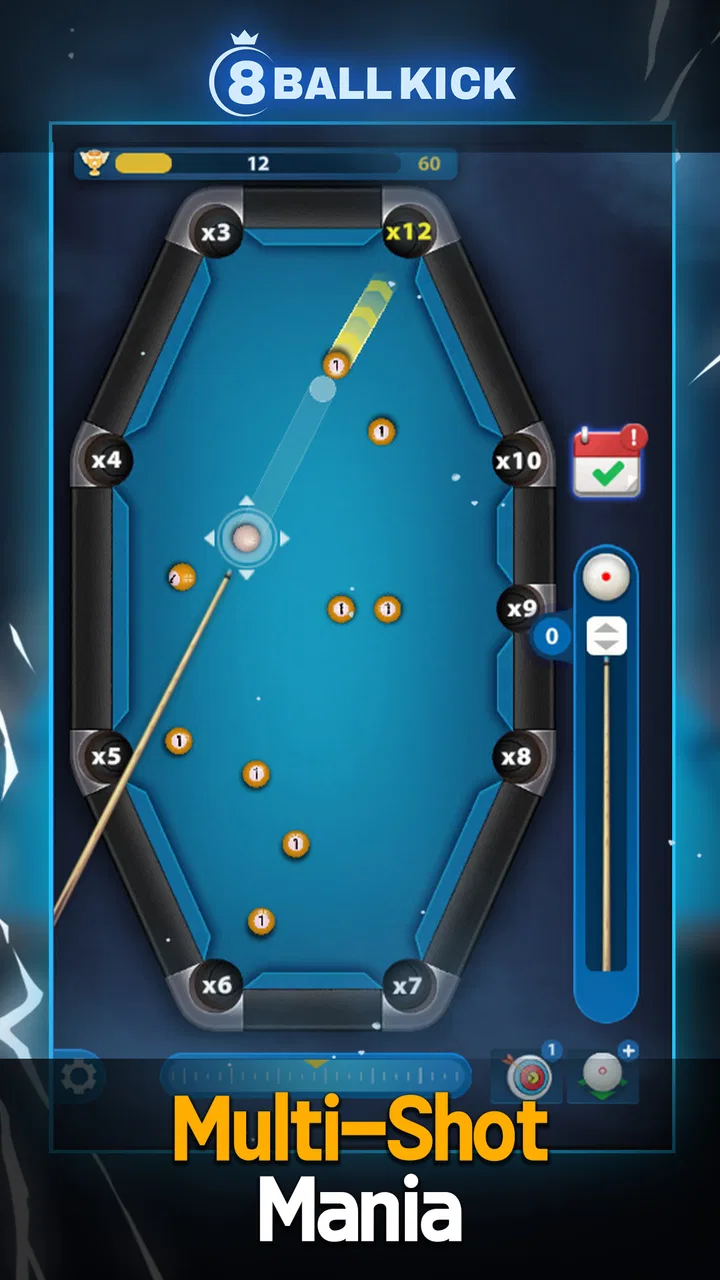
8 Ball Kick
- 4.5
- Rating
- 10.00M
- Installs
- Free
- Price

 Analysis by App-foxy
8 Ball Kick is a free puzzle game built around a simple promise: make one shot count. I found its appeal in the quick decision-making rather than in a large amount of explanation. You look at the table, judge the available path, and try to turn a limited opportunity into a successful finish. That makes it easy to understand within moments, but not necessarily easy to play well.
The game comes from execl marocco and has attracted a substantial audience, with an average rating of 4.5 from around 226 thousand ratings and more than 10 million installs. Those figures suggest that the basic idea connects with a wide range of players. My own view is more measured: it is a good fit for short puzzle sessions and players who enjoy aiming carefully, but it is less suitable if you want a full pool simulation with extensive rules, long matches, or a large competitive feature set.
Getting started without wasting your first attempts
The first place many players get stuck is not the puzzle itself, but the transition from opening the game to understanding what a successful shot requires. The short description, “8 Ball Kick,” gives you the theme but not much practical guidance. I would approach the opening session as a learning period rather than immediately treating every missed shot as a failure.
You May Also Like

 Blood Strike: 2.5 Anniversary
Blood Strike’s Loadouts Turn Every Drop Into a Tactical Gamble
A close look at Blood Strike’s custom loadouts: how fast access to signature weapons reshapes its battle royale rhythm, rewards preparation, and narrows the gap between fights.

 Pandora - Music & Podcasts
Pandora’s Music Is Easy to Start, but Harder to Recover
Pandora’s strength is its low-effort path from a seed to a station. Its weak spot is how much confidence it asks you to place in connection, setup, and quiet recovery.

 8 Ball Pool
 Is Built on Rivalries, Rematches, and Routine
A close look at the rivalries, rematches, shared routines, and unanswered safety questions that turn a quick pool match into a persistent mobile community.

 Samsung Music
’s Quiet Strength Is Playing What You Already Own
Its reach comes less from spectacle than from dependable access to a personal library. That simplicity is both the app’s strongest retention engine and its ceiling.

 AccuWeather: Weather Radar
AccuWeather Review: A Quick, Clear Forecast for Everyday Decisions
For everyday plans, the best forecast is the one you can understand quickly. AccuWeather makes rain timing, radar, and local conditions easy to act on, with a few trade-offs.

 Hill Climb Racing
Why Hill Climb Racing Still Turns Crashes Into One More Run
A tiny car, a bumpy hill and one more upgrade: Hill Climb Racing keeps resurfacing because its simple chaos makes every near-miss feel personal.
More From Our News Desk



Before trying to play quickly, spend a moment checking how the aiming control responds. A small movement can change the intended line, especially when the target is close to a cushion or another ball. The useful habit is to make a deliberate adjustment, pause, and then release. Dragging rapidly can feel natural on a phone, but it makes it harder to tell whether a miss came from the chosen angle or from an imprecise gesture.
There is also a mental trap in the one-shot concept. Players often focus on the target ball and ignore the final position of the cue ball. Even when the immediate objective looks obvious, the best attempt usually begins with a wider view of the table. I look for the safest route first, then consider whether a more ambitious angle is worth the risk. That approach is especially helpful when several balls appear to offer possible solutions.
If the controls feel unresponsive, do not immediately assume the game is broken. First check whether your finger is covering the point you are trying to judge. On a small screen, the aiming line and the target can compete for space under your hand. Rotating the phone, cleaning the display, or using a lighter touch can make the interaction easier without changing any game setting.
Another common source of confusion is expecting conventional pool behavior from a puzzle designed around a single decisive attempt. Traditional pool games reward planning across a sequence of shots, while this title places more attention on the immediate setup. If you approach every board as though you are preparing a long break, you may spend too much time searching for a perfect continuation that the puzzle does not require.
Simple checks before blaming the game
For a smoother first session, I would use a short routine:
- Hold the phone steadily and make sure your touch begins on the intended control area.
- Study the direct path before attempting bank shots or tighter angles.
- Move the aim slowly enough to see when the line changes.
- Use an early attempt to learn the release timing instead of chasing a perfect result.
- Restart your thinking, not necessarily the application, after a miss: identify whether the angle, force, or timing caused it.
This routine sounds basic, but it addresses the main friction of a compact physics puzzle: the difference between understanding the goal and controlling the shot precisely. I found that deliberate input mattered more than speed. Players who prefer rapid tapping may need a few attempts before the game feels predictable.
The age classification is Mature 17+, so I would not choose it for a child’s device simply because the controls look accessible. The rating is part of the practical decision about who should use it. For an adult looking for a brief puzzle, that classification may not affect the experience, but families should still take it seriously rather than judging the game only by its pool-like presentation.
What to check when installation or opening goes wrong
The game supports Android 7.0 and later, which covers many older devices but not every phone still in use. If it will not install, the first useful check is the operating system version. A device that works well with other games may still be outside this title’s supported range.
Storage is another sensible check. Even when a game itself is not especially large, a nearly full phone can cause installation or update problems. I would remove temporary files or unused applications before repeatedly trying the same download. It is also worth confirming that the store account is using a stable connection and that the phone has enough battery for the installation process to finish.
The current version is 1.0.2.4. If the game opens but behaves differently from what you expect, check that the installed copy is current before drawing conclusions from an older build. Updates can change how a control feels or correct problems that appeared only on particular devices. I would also close other demanding applications and reopen the game once after an update, since a clean launch is a better test than continuing with a partially refreshed session.
When an installation stops halfway, repeated tapping on the install button rarely helps. I prefer to pause, verify the connection, check available storage, and then try again. If the phone is using mobile data, a weak signal can look like an application fault even though the real problem is the download. Switching to a stable network is a more useful first step than changing gameplay settings that cannot affect installation.
Because the game is free, the financial barrier is low, but that does not remove the practical cost of testing it. Your time is still involved, and an older phone may provide a less comfortable experience than a newer one. I would give the game a fair trial on a supported device, then decide based on touch accuracy and stability rather than assuming that a free download must suit every handset.
Recovering your rhythm after a missed shot
A missed attempt can create a cycle of increasingly hurried decisions. I have found that the best recovery is to separate observation from action. On the next board, first identify the target and the likely contact point. Only after that should you decide how much force or adjustment the shot needs. This prevents the previous mistake from turning into a new, unrelated one.
One useful technique is to treat the table as a set of angles rather than as a collection of objects. Imagine the path from the cue ball to the target, then consider where the target would travel after contact. If a cushion is involved, check the rebound route before committing. This does not guarantee success, but it gives each attempt a reason. Randomly changing the aim after every miss makes it difficult to learn anything.
When a shot fails by a small margin, change only one variable on the next attempt. If you alter the angle, force, and release timing together, you cannot tell which adjustment helped. I would begin with the angle because it usually has the clearest effect on the intended contact. If the line looks correct but the result is still short or too strong, then refine the force.
This single-variable method is one of the more valuable ways to use the game as a puzzle rather than as a reflex challenge. It also makes short sessions feel productive. Even when I do not complete a board immediately, I can understand why the previous attempt failed and apply that lesson to the next one.
Another recovery tip is to stop after a sequence of rushed failures. The game’s compact format makes it tempting to keep tapping until the result changes, but frustration often reduces precision. A short pause can restore attention, particularly when the screen is small and the aiming line is difficult to read. I would rather return after a minute with a clear plan than continue making identical mistakes.
Separating control problems from puzzle problems
It helps to distinguish three different failures. A poor angle means the planned path was wrong. A poor force means the path was reasonable but the shot did not travel as intended. A poor input means the game may not have received the gesture you meant to make. These can look similar when the ball misses, but they require different responses.
If the same gesture produces noticeably different results, check your touch position and movement speed before redesigning the solution. If the result is consistent but unsuccessful, the puzzle approach is more likely to need adjustment. If the game freezes, closes, or refuses to respond, leave the board and restart the application once. General troubleshooting is more useful here than repeatedly replaying the same shot.
I would also avoid judging the whole game from one difficult board. Puzzle games can create a sharp difference between a layout that feels immediately readable and one that demands several attempts. The important question is whether the challenge teaches you something. If each failure reveals a clearer relationship between angle and outcome, the difficulty feels fair. If you cannot identify what changed, the experience becomes more frustrating than thoughtful.
Players moving from a conventional pool app may need to adjust expectations about precision. A simulation often gives you a broad match structure, multiple shots, and room to recover from a bad decision. Here, the pressure of a single attempt makes small errors more important. That is the central trade-off: the game is quicker to enter, but each input carries more weight.
When the application is not the real cause
Some apparent problems come from the phone environment. A screen protector with poor touch sensitivity can make slow aiming feel uneven. Finger moisture, a dirty display, or accidental contact from the edge of the hand can also interfere with a precise gesture. Testing the same control with a clean, uncovered portion of the screen can help isolate the issue.
Performance can be affected by the device as well. If other applications are running heavily, closing them may improve responsiveness. I would not treat a warm phone or a low-battery warning as proof that this particular game is at fault. Letting the device cool down, charging it, and restarting can provide a clearer test.
Network conditions may matter during installation or any part of the experience that needs a store connection, but a poor connection cannot explain every gameplay miss. Once a board is active, a failed angle remains a gameplay issue rather than a network issue. Keeping those causes separate prevents unnecessary troubleshooting and helps you decide whether the problem is technical or simply a difficult puzzle.
There is also a difference between a feature you want and a fault you are experiencing. If you are looking for long matches, advanced cue customization, or a detailed multiplayer structure, their absence would be a reason to choose another kind of pool game, not evidence that this puzzle is malfunctioning. I would compare the actual design with your expectations before spending time searching through settings for a mode that may not be central to the experience.
The developer, execl marocco, has positioned the game around a focused puzzle idea rather than a broad pool package. That focus is useful for players who want a quick challenge, but it naturally limits the appeal for people seeking a complete simulation. In my experience, the right comparison is not “Does it replace every pool game?” but “Do I want a short, one-shot puzzle when I pick up my phone?”
Who will enjoy it, and who should skip it
I would recommend it to adults who like compact challenges, careful aiming, and the satisfaction of improving through small corrections. It works well during a short break, while waiting for an appointment, or at the end of the day when you want interaction without committing to a long match. The free price also makes it easy to test without planning a purchase first.
A realistic everyday scenario would be a player using the game for a few minutes during a commute, with the phone held in one hand and attention divided between the screen and the surroundings. That is where I would be cautious. Precise shots are harder when you are moving, standing, or distracted. The game is better suited to a stable seat and a moment when you can concentrate, even though individual attempts are brief.
I would skip it if your priority is a realistic pool table, a long-form career, or a social match with friends. A traditional billiards game is likely to be better for practicing full rules and planning several shots ahead. A broader arcade title may also suit you more if you want power-ups, character progression, or a more varied action loop. This game’s strength is its narrow focus, and that is also its main limitation.
Players with limited touch control may find the aiming demands tiring, particularly on a small display. The game can be approachable in concept while still requiring careful finger movement. If accessibility depends on large controls, voice input, or extensive adjustment options, I would test the basic aiming interaction early and avoid assuming that a simple objective means effortless control.
My practical verdict after using it
8 Ball Kick succeeds when I treat it as a focused puzzle about judgment, not as a replacement for a complete pool simulator. The best sessions come from slowing down, reading the angle, changing one variable at a time, and accepting that a missed shot can be useful feedback. Its strongest quality is the immediacy of the challenge: there is little distance between seeing a problem and attempting a solution.
Its friction is equally clear. Small-screen aiming can demand more precision than the brief format suggests, and the Mature 17+ classification means it is not a casual family recommendation. Installation problems should be investigated through operating-system support, storage, connection, and device condition before blaming the game. Once those basics are clear, the remaining question is whether its one-shot structure matches your taste.
The game was released on March 23, 2026, and its current version is 1.0.2.4. I would keep those details in mind when checking compatibility and updates, especially on an older Android device. With Android 7.0 or later, a stable installation, and a screen that registers controlled gestures properly, it is worth trying for short puzzle sessions.
My recommendation is straightforward: download it if you want a free, concentrated aiming challenge and enjoy learning from small mistakes. Choose a conventional pool game instead if you want extended matches, deeper simulation, or a stronger social structure. For the right player, the one-shot format turns a familiar pool idea into a neat test of patience and precision; for everyone else, it may feel too narrow once the novelty wears off.
FAQs for 8 Ball Kick
01What is 8 Ball Kick, and how is the game played?
8 Ball Kick combines traditional pool mechanics with a more action-focused kicking style. You aim, adjust the direction and power of your shot, and try to clear the table while following the rules of the selected mode. The game is easy to understand at first, but accurate positioning, controlled power, and planning several shots ahead become increasingly important as the challenges get harder.
02Can I play 8 Ball Kick without an internet connection?
Some parts of 8 Ball Kick may be available offline, particularly basic practice or single-player content, but online features generally require an active internet connection. Multiplayer matches, rankings, advertisements, cloud-related functions, and certain events may not work offline. Availability can also depend on the version installed, so it is worth checking the game’s current requirements before downloading it.
03Does 8 Ball Kick include multiplayer or competitive features?
8 Ball Kick is designed to offer competitive pool-style gameplay, and supported versions may include matches against other players, challenges, leaderboards, or progression-based competitions. Online play can be more demanding than casual practice because connection quality affects the experience. Players should also expect opponents with different skill levels and possible competitive rewards or ranking systems.
04Is 8 Ball Kick free to download, and does it contain purchases?
The game can generally be downloaded at no initial cost, but free access may be supported by advertising, optional purchases, or both. Depending on the version, players may encounter items such as coins, cosmetic upgrades, extra attempts, or other progression-related benefits. Always review the store listing and in-app purchase information, especially if children may use the device.
05What devices and permissions are required to run 8 Ball Kick?
8 Ball Kick is intended for compatible Android or iOS smartphones and tablets, although the exact operating-system requirements can change with updates. A stable installation requires sufficient storage space, and online functions may need permission to use the internet. Performance can vary on older devices, so users should check the official store page for supported versions, size, and compatibility details before installing.
Pros
- Simple controls make it easy for beginners to start playing.
- Quick matches are suitable for short gaming sessions.
- Pool-style physics make successful shots feel satisfying.
- The game offers a casual way to practice aiming and timing.
- Lightweight gameplay should run well on many mobile devices.
Cons
- Limited depth may reduce long-term appeal for experienced pool players.
- Ads may interrupt the experience between matches.
- Some features may require in-app purchases or extra progression.
- Touch aiming can feel imprecise on smaller screens.
- Offline options and multiplayer availability may be limited.

8 Ball Kick
Gallery